 How to Find Buyers and Distributors in Italy: A Practical Guide for Foreign Companies
Finding the right distributor, buyer or commercial partner in Italy can be one of the most challenging steps for a foreign company entering the Italian market.
Italy is one of Europe’s largest economies and offers significant opportunities across food, healthcare, manufacturing, construction, technology and consumer goods. However, simply creating a database of Italian companies and sending introductory emails rarely produces the expected results.
To successfully find distributors in Italy, foreign companies need to identify the right route to market, select qualified prospects, reach the actual decision-makers and follow up consistently.
At Do Business in Italy, we support international companies throughout this process, acting as a local business development partner directly in the Italian market.
How to Find Distributors in Italy
The first step is not searching for as many Italian companies as possible.
It is understanding what kind of partner your company actually needs.
Depending on the product and sector, the best route to the Italian market could involve:
- an importer;
- a national or regional distributor;
- a wholesaler;
- a commercial agent;
- a retailer or retail chain;
- an industrial buyer;
- a direct B2B customer.
Before beginning outreach, foreign companies should therefore analyse the market and define the profile of their ideal Italian partner.
A targeted search for 30 highly relevant companies can often be more valuable than a generic database containing hundreds of contacts.
Why Is It Difficult to Find Buyers in Italy?
Foreign companies frequently start their search by compiling a list of potential Italian distributors and sending introductory emails.
Response rates can be disappointing.
This does not necessarily mean that the product has no potential in Italy.
Italian B2B markets are often relationship-driven, and buyers receive numerous commercial proposals. Generic introductions sent to general company email addresses may never reach the person responsible for purchasing or business development.
The real challenge is therefore not simply finding Italian companies.
It is finding the right companies, identifying the right decision-makers and creating a relevant reason for them to start a conversation.
Start with Italian Market Qualification
Before contacting potential buyers or distributors, it is important to understand where the product fits within the Italian market.
A preliminary market assessment should answer practical questions such as:
Who buys this type of product in Italy?
The apparent distribution channel is not always the most effective one.
For example, an international food producer may initially search for an Italian importer while the most interesting opportunity could be direct supply to a food manufacturer.
A building-material producer may look for one national distributor when specialised regional distributors, architects, contractors or other professional operators could represent more suitable targets.
Who are the existing competitors?
Understanding which products are already available in Italy provides useful information about positioning, pricing, distribution channels and potential market gaps.
What does an Italian buyer expect?
Price is important, but it is rarely the only factor.
Depending on the sector, Italian buyers may evaluate certifications, minimum order quantities, logistics, delivery times, technical assistance, product customisation, private-label opportunities and existing European references.
Market qualification should therefore come before large-scale commercial outreach.
How to Identify the Right Italian Distributors and Buyers
Once the target profile has been established, potential partners can be identified and qualified.
The analysis should go beyond basic company information.
Whenever possible, it is useful to understand:
- which products and brands the company already represents;
- which customer segments it serves;
- its geographic coverage;
- whether it imports directly;
- whether competing or complementary products are already present in its portfolio;
- who is responsible for purchasing, sourcing or business development.
This qualification process helps concentrate commercial activity on companies with a realistic potential interest.
Reaching the Right Decision-Makers in Italy
Finding a suitable Italian company is only half of the work.
The next challenge is identifying the person who can actually evaluate the proposal.
Depending on the organisation, this may be a Purchasing Manager, Category Manager, Procurement Manager, Commercial Director, Import Manager, Business Development Manager or directly the owner or Managing Director.
This is particularly important in the Italian SME market, where organisational structures can differ considerably from those of larger international corporations.
Communication should also be adapted to the recipient.
A purchasing manager does not need a generic corporate presentation. The initial approach should explain clearly what is being offered, why it could be relevant to the Italian company and why a conversation may be worthwhile.
Trade Fairs in Italy: The Real Work Starts Before and After the Event
Italy hosts some of Europe’s most important international B2B exhibitions.
Events such as TUTTOFOOD Milano for the food industry and Klimahouse for sustainable construction and building solutions provide excellent opportunities to understand the market, meet industry operators and test commercial interest.
However, attending or exhibiting at a trade fair does not automatically create a distribution network.
During TUTTOFOOD Milano 2026, while supporting international food producers interested in developing business in Italy, we saw once again that the real commercial value of a trade fair depends heavily on the work carried out before and after the exhibition.
Potential buyers and partners should be identified before the event whenever possible. Meetings can then be arranged in advance.
After the fair, contacts need to be qualified and followed up consistently.
Some of the most promising commercial discussions may develop several weeks or even months after the first meeting.
From an Italian Buyer Contact to a Commercial Opportunity
A buyer expressing initial interest is not yet a commercial result.
The following stages may involve:
- exchanging technical documentation and certifications;
- providing product specifications;
- discussing prices and commercial conditions;
- sending samples;
- evaluating logistics and minimum quantities;
- arranging a video call;
- organising an in-person meeting in Italy;
- testing the product;
- negotiating supply or distribution conditions.
At any one of these stages, communication can stop.
This is where continuous local follow-up becomes particularly valuable.
A local business development partner can facilitate communication between the foreign supplier and the Italian company, clarify requests and keep the commercial process moving.
Do You Really Need an Italian Distributor?
Not necessarily.
Finding a distributor is often considered the default strategy for entering a foreign market, but different business models may be more appropriate.
Italian importer or distributor
This can be the right solution when local stock, logistics, technical assistance or an established sales network are essential.
Direct B2B sales to Italian companies
Direct sales can be particularly effective for industrial products, ingredients, raw materials, specialised equipment and other B2B solutions.
In these cases, the foreign supplier may sell directly to Italian manufacturers or professional customers.
Commercial agent in Italy
An agent can provide continuous commercial coverage without requiring the foreign company to establish its own subsidiary.
Local business development partner
This model can be useful for companies that first want to test the Italian market, identify potential buyers and develop commercial opportunities before committing to a permanent local structure.
For many international SMEs, this represents a flexible way to evaluate the real potential of Italy while reducing the initial investment and risk.
How Do Business in Italy Supports Foreign Companies
Do Business in Italy supports foreign companies seeking buyers, distributors and commercial partners in the Italian market.
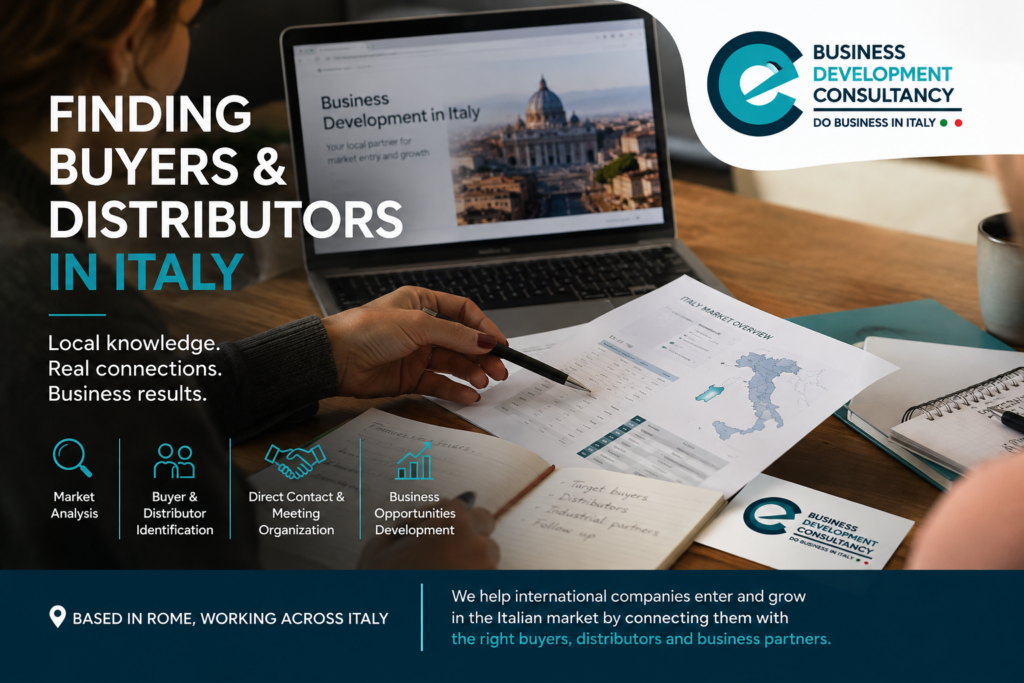
Depending on the project, our business development services can include:
- Italian market assessment;
- route-to-market analysis;
- identification of potential buyers and distributors;
- company and decision-maker research;
- direct B2B outreach;
- communication with Italian prospects;
- commercial follow-up;
- organisation of video calls and meetings in Italy;
- assistance during negotiations;
- trade-fair support;
- local representation and ongoing business development.
The objective is not simply to provide a database.
Our role is to identify relevant Italian companies, open conversations with the right people and help transform qualified contacts into concrete business opportunities.
Looking for Buyers or Distributors in Italy?
If your company is considering entering the Italian market, the first step is understanding whether there is a realistic opportunity and identifying the most appropriate route to market.
Whether you are looking for an importer, distributor, industrial buyer or direct B2B customer, having someone operating locally can make the process considerably more efficient.
Do Business in Italy can support your company directly from Italy, from initial market exploration and partner identification to outreach, meetings and commercial follow-up.
Contact us to discuss your Italy market entry and business development project.
Frequently Asked Questions About Finding Distributors in Italy
How can I find a distributor in Italy?
Start by defining the appropriate distribution channel and the profile of your ideal partner. Potential distributors should then be qualified according to their products, customers, geographic coverage and compatibility with your offer. The next stage is identifying and contacting the relevant decision-makers.
How can a foreign company find buyers in Italy?
Foreign suppliers can identify Italian buyers through market research, sector databases, trade fairs, industry associations and direct company research. However, identifying companies is only the first stage. Direct outreach and systematic follow-up are normally required to develop commercial opportunities.
Do I need a distributor to sell products in Italy?
Not always. Depending on the product and industry, foreign companies may sell directly to Italian manufacturers, wholesalers, retailers or professional customers. An importer, agent or distributor may be more appropriate when local stock, sales coverage or technical assistance is required.
Can a foreign company sell directly to Italian companies?
Yes. Direct B2B sales are possible in many sectors, particularly for industrial products, ingredients, raw materials, equipment and specialised solutions. The appropriate structure depends on the product, logistics, regulatory requirements and level of local support required.
Is Italy a difficult market for foreign companies?
Italy offers substantial opportunities but the market can be fragmented and relationship-driven. Local market knowledge, communication with the appropriate decision-makers and consistent commercial follow-up can facilitate market entry.
What does an Italy market entry consultant do?
An Italy market entry consultant can help a foreign company assess the market, identify potential buyers and distributors, approach decision-makers, organise meetings and provide local support during business development.
Can Do Business in Italy contact Italian buyers on behalf of foreign companies?
Yes. Do Business in Italy supports international companies with buyer and distributor identification, direct B2B outreach, meeting organisation, commercial follow-up and local business development in Italy.