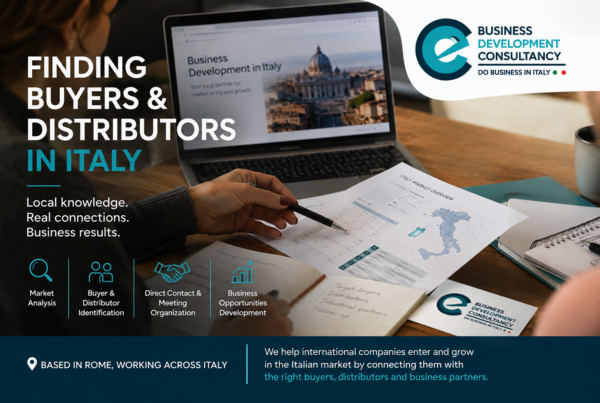
The Seven-Step Business Development Process: help companies to expand their business in Italy.

Italy, with its rich history and diverse business landscape, offers a plethora of opportunities for companies looking to grow.
However, breaking into the Italian market requires a well-structured and systematic approach.
Are you wondering what needs to be done to enter your products/services in the italian market?
In this article, we will explore a comprehensive business development process designed to help foreign companies establish a foothold in Italy.
One touch point for sales and marketing when you start doing business in Italy
For everyone who wants to establish a business in Italy, this is a very succesful method I use to accompany companies in the first steps of commercial activity in Italy.
- Initial Meeting: The firs phase begins with a crucial initial meeting. Business development consultants sit down with the foreign company to understand its business, value proposition, objectives, and target market or potential partnerships in Italy. This stage is essential for setting the foundation and aligning strategies;
- Competitor Analysis: To thrive in a new market, it’s essential to understand your competition. Consultants conduct a thorough analysis of both online and offline competitors to gain insights into the competitive landscape in Italy. This information will guide strategic decision-making.
- Campaign Objectives Definition: Clear objectives are vital for measuring success. The consultant, based on information from the initial meeting, defines specific campaign objectives. These objectives might include the number of qualified leads, partners, or clients the foreign company aims to acquire in Italy.
- Database Profiling: With objectives in mind, the consultant constructs a database of potential clients, partners, or relevant contacts. This database includes contact details and other information about potential leads. The database’s construction is based on priorities and objectives outlined in the initial meeting.
- Marketing Material Review and Creation: Effective communication is key to success. The consultant reviews existing marketing materials and creates new materials in Italian, such as flyers, institutional brochures, landing pages, websites, and social media pages. These materials are designed to convey the foreign company’s value proposition to the Italian audience effectively.
- Contact: The consultant initiates contact with potential clients through various means, including phone calls, emails, or in-person visits. During these interactions, the consultant presents the products or services of the foreign company, highlighting their value to the Italian market.
- Lead Generation and Meetings: As potential clients show interest, the consultant creates a list of qualified leads. They may then organize meetings or introductions between the foreign company and these potential clients, facilitating the expansion of the business.
Benefits of the Seven-Step Business Development Process in Italy
- Market Research: Through the initial stages of the process, foreign companies gain valuable insights into the Italian market. This knowledge empowers them to make informed decisions and tailor their strategies to the specific needs and preferences of Italian consumers.
- Lead Activation: The process actively engages potential clients and partners, helping to activate qualified leads. It shifts the business’s focus from passive waiting to proactive outreach, increasing the chances of success.
- New Partnerships and Clients: The ultimate goal of the process is to establish new partnerships and acquire clients in the Italian market. Through the systematic approach outlined in these seven steps, foreign companies increase their chances of successfully breaking into the Italian market, expanding their reach and achieving growth.
Things to remember when doing business in Italy:
- Personal relationships and direct knowledge are very important, even more so if your company is introduced by trusted people, for example through a reference. Having a professional available in the area who represents your company is essential, as is the network of contacts available to the business consultant. He will be able to introduce you to his network of contacts and partners and equally develop cold contacts, presenting your references in the market and identifying potential contact points.
- Institutional relations sometimes are crucial: building institutional relationships is vital for some business, I can help companies in building a contact with the italian Public Administration and lobbies.
- Quality matters a lot in Italy If you want to export your products or services you need to know that quality is very important in Italy! Before exporting you have to be complied with all procedures
- Effective Business feedback are often not quick, it also depends above all on the regions in which one works. It therefore becomes more complicated to keep track of the follow-ups of potential customers. It often takes 2-3 phone calls before getting a response even just regarding the possibility of a meeting (virtual or not)
- Working only with emails is a waste of time, the most valuable sales contact in Italy is the direct one: telephone, visit or meeting.
Conclusion
Expanding into the Italian market can be a highly rewarding venture, but it requires a structured and systematic approach.
The seven-step business development process described here serves as a valuable road map for foreign companies seeking to establish a presence in Italy.
By following these steps, businesses can effectively navigate the intricacies of the Italian market, capitalize on opportunities, and achieve their growth objectives.
With the right strategy, Italy’s rich business landscape can become a thriving platform for success.
If you’re interesting in knowing more about Business Development Process in Italy, fix a free call or fill the form.